
How to Choose an Automated Guided Vehicle?
Choosing an automated guided vehicle is a process decision, not simply a vehicle purchase. The right model must fit your routes, loads, floors, workers, and production rhythm. A vehicle carrying 1,000 kilograms may look impressive, yet fail on narrow aisles or uneven surfaces. Small details matter.
Robotics pioneer Joseph F. Engelberger once advised, “The key to successful robotics is to know when to use a robot and when not to.” This principle applies directly to automated guided vehicle selection. Before comparing suppliers, measure travel distances, loading points, battery cycles, traffic peaks, and manual handling time. Observe the real workflow. Spreadsheets alone can hide delays.
Consider navigation technology, safety sensors, payload stability, charging methods, software integration, and service support. Ask whether the vehicle can communicate with your warehouse management system. Check how it behaves when a pallet is misplaced or an aisle becomes blocked. Recovery matters.
Test before committing.
A controlled pilot can expose problems that demonstrations conceal. It may reveal poor turning performance, noisy alerts, or charging interruptions during a night shift. These findings are valuable, even when they challenge the original plan. Total cost should include installation, training, maintenance, spare parts, and downtime. Supplier experience also deserves careful review. Request references from facilities with similar loads and operating hours. An honest evaluation may conclude that one automated guided vehicle is enough, or that automation should wait. The strongest choice is practical, measurable, and safe for the people working beside it.
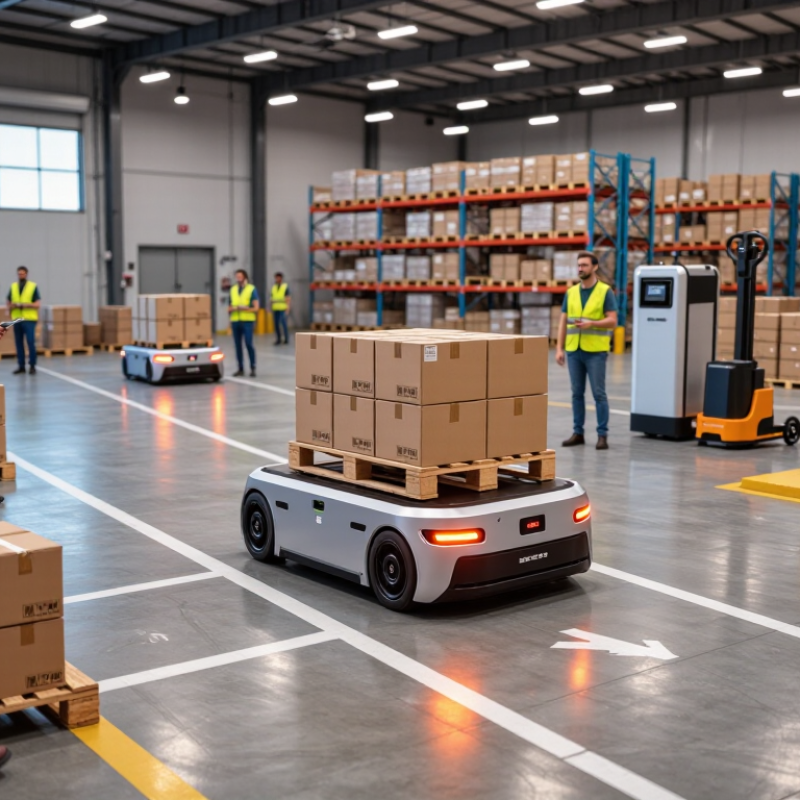
Define the AGV’s Operational Requirements
How to Choose an Automated Guided Vehicle?
Define the AGV’s Operational Requirements
Begin with the work, not the vehicle. Observe each route during a normal shift. Record load weight, dimensions, pickup height, and delivery frequency. Note narrow aisles, floor joints, ramps, dust, and changing light conditions. A 500-kilogram load may require different handling than its weight suggests. Its center of gravity and packaging stability also matter.
Map the real traffic pattern. Measure travel distance, waiting time, turning space, and pedestrian crossings. Define the required throughput by hour, not by average day. Include peak periods, shift changes, and temporary storage. Check charging access and battery recovery time. The AGV should communicate with doors, elevators, and production systems when needed. In practice, small delays often create larger bottlenecks. A clean plan can still be wrong.
Tips: Build a simple route log. Include photos, measurements, and operator comments. Test one representative route before final selection. Ask operators where loads actually wait. Their experience may challenge the process map. Define measurable targets, such as 30 deliveries per hour or fewer than two manual interventions per shift. Leave room for revision. Operational requirements change when products, staffing, or layouts change.
| Requirement Area | Key Metric | Typical Planning Data | Why It Matters | Recommended Validation Method |
|---|---|---|---|---|
| Load Handling | Maximum payload | 500–2,000 kg for common unit-load AGVs | The AGV must safely carry the heaviest expected load, including packaging, pallets, containers, and handling fixtures. | Record the maximum gross load and add an engineering safety margin based on the application risk assessment. |
| Load Handling | Load dimensions | Measure length, width, height, and center of gravity | Oversized or uneven loads can affect vehicle stability, aisle clearance, turning behavior, and sensor performance. | Measure representative loads at their maximum size and verify the load’s center of gravity and support points. |
| Load Handling | Pickup and drop-off accuracy | Typically specified in millimeters according to the workstation design | Accurate positioning is required for conveyors, racks, production equipment, elevators, and automated storage interfaces. | Define the required transfer tolerance at every pickup and delivery location. |
| Travel Performance | Operating speed | Approximately 0.8–2.0 m/s, subject to load, traffic, and safety limits | Higher speed can improve throughput, but it may increase stopping distance, interaction risks, and space requirements. | Calculate speed requirements from route length, task frequency, pedestrian traffic, and required cycle time. |
| Travel Performance | Acceleration and deceleration | Must be compatible with load stability and floor conditions | Sudden changes in motion may shift unsecured loads, spill materials, or reduce operator and pedestrian comfort. | Test the heaviest and most unstable loads on representative routes and slopes. |
| Route Environment | Aisle width and turning radius | Determine from vehicle dimensions, steering type, load size, and turning geometry | Insufficient clearance can cause collisions, blocked traffic, excessive maneuvering, and reduced system capacity. | Survey the narrowest aisles, intersections, doors, rack ends, and staging areas. |
| Route Environment | Floor condition | Smooth, level, clean, and suitable for the selected navigation and wheel system | Uneven floors, expansion joints, debris, moisture, and poor traction can affect localization, braking, and load stability. | Inspect floor flatness, surface damage, slopes, joints, contamination, and drainage conditions. |
| Route Environment | Environmental conditions | Temperature, humidity, dust, washdown exposure, and lighting must be defined | Environmental conditions influence battery life, sensors, electronics, corrosion resistance, and maintenance requirements. | Document the minimum and maximum conditions for every operating zone, including cold rooms and wash areas. |
| Navigation | Navigation method | Laser-based, vision-based, magnetic, QR-code, or fixed-route guidance | The navigation method affects installation effort, flexibility, accuracy, performance in changing layouts, and maintenance. | Compare the required route flexibility, infrastructure availability, lighting, dust level, and layout stability. |
| Traffic Management | Mixed traffic | Define pedestrian, forklift, tugger, conveyor, and vehicle interaction levels | AGVs operating around people and manually driven equipment require suitable detection, warning, stopping, and traffic-control functions. | Map traffic density by time of day and identify shared crossings, blind corners, and restricted zones. |
| Throughput | Required transport rate | Tasks per hour or loads per shift, including peak demand | Throughput determines the required fleet size, route design, charging strategy, buffer capacity, and dispatch logic. | Calculate demand using average and peak transport requests, route distance, loading time, unloading time, and waiting time. |
| Throughput | Cycle time | Travel time + loading + unloading + waiting + traffic delays | Ignoring non-travel time can lead to an undersized fleet and missed production or warehouse targets. | Measure the complete end-to-end cycle for representative missions rather than estimating travel time alone. |
| Battery and Charging | Operating time per charge | Define required hours, missions, or distance between charging opportunities | Battery capacity must support the planned workload without causing unexpected interruptions or excessive charging queues. | Estimate energy consumption from payload, travel distance, speed, stops, lifts, environmental conditions, and utilization. |
| Battery and Charging | Charging strategy | Opportunity charging, scheduled charging, battery exchange, or automated charging | The charging method affects vehicle availability, floor-space requirements, labor, battery life, and production continuity. | Identify available charging locations, allowable downtime, shift patterns, and the consequences of a low-battery event. |
| Automation Integration | System interfaces | Warehouse management, manufacturing execution, fleet management, conveyors, doors, lifts, and safety systems | Reliable communication is essential for mission assignment, status tracking, equipment handshakes, and exception handling. | Define required data points, communication protocols, response times, ownership of commands, and failure procedures. |
| Safety | Risk controls | Obstacle detection, emergency stops, warning devices, speed zones, and safe stopping behavior | Safety functions must address foreseeable interactions with people, equipment, structures, loads, and unexpected obstacles. | Complete a documented risk assessment using applicable machinery and mobile-robot safety requirements in the target jurisdiction. |
| Availability | Target system availability | Set a measurable target based on production or warehouse operating hours | Availability requirements influence fleet redundancy, spare capacity, preventive maintenance, battery strategy, and support planning. | Define acceptable downtime, recovery time, backup procedures, and the required number of available vehicles during peak periods. |
| Scalability | Future expansion | Consider additional vehicles, routes, stations, shifts, and load types | A scalable solution can reduce future redesign costs when production volume, storage capacity, or facility layout changes. | Document expected growth over the planning period and test whether the control system, charging area, and routes can support it. |
| Maintenance | Service requirements | Inspection frequency, spare parts, software support, tire or wheel wear, and battery maintenance | Maintenance requirements affect total operating cost and the time vehicles remain unavailable. | Request a preventive-maintenance schedule and estimate labor, spare parts, tools, training, and service response times. |
Related Posts
-
What Is an Automated Guided Vehicle System?
-
How to Choose AGV AMR Robots for Your Warehouse?
-
How to Choose the Right AGV Robot for Your Business?
-
China Top 10 Automated Guided Vehicle System Suppliers
-
10 AMR Automation Tips for Global Warehouse Buyers
-

Top AI and Robotics Tips for Global Buyers and Suppliers?