How to Meet RIA Standards for Industrial Robots?
Industrial robots can improve speed, consistency, and worker safety, but compliance cannot be reduced to installing a guard. Meeting ria standards requires a disciplined process, from initial risk assessment to final validation. ANSI/RIA R15.06 provides an important framework for industrial robot safety, while related standards may apply to integrated systems, end effectors, and control functions.
A reliable approach begins on the factory floor. Observe how operators load parts, clear jams, teach positions, and respond to alarms. Document each task. Check reach distances, access points, emergency stops, protective devices, and restricted zones. Small details matter. A loose interlock cable or poorly placed reset button can weaken an otherwise strong design. Engineers should involve operators, maintenance staff, integrators, and qualified safety professionals during the review.
Paperwork alone is not enough. Test the system under realistic conditions, including faults, power interruptions, and unusual workpieces. Record test results, corrective actions, training records, and approval decisions. The latest applicable editions should always be verified before implementation, because standards and interpretations can change. A checklist may appear complete while missing a practical hazard. That is where honest review matters. This guide explains the major steps for aligning industrial robot applications with ria standards, while recognizing that every cell has different equipment, tasks, and risks. When uncertainty remains, seek competent professional advice rather than guessing.
Understanding RIA Standards and Their Role in Industrial Robot Safety
How to Meet RIA Standards for Industrial Robots?
RIA standards provide a practical framework for safer industrial robot integration. They address robot design, installation, safeguarding, operation, and maintenance. Their central purpose is risk reduction, not paperwork completion.
A responsible safety process begins with a documented risk assessment. Review every movement, tool, material, and nearby task. Identify crushing points, unexpected starts, and access routes. Then select controls that match the actual hazard. Physical barriers, interlocked gates, emergency stops, and presence-sensing devices may work together. Each safeguard needs a clear purpose. Workers should understand what it protects and when it can fail.
Safety depends on validation after installation. Test stopping distances, gate switches, control circuits, and restricted spaces under realistic conditions. Keep inspection records, training evidence, and maintenance logs available. Procedures should explain normal operation, recovery from faults, and authorized access. Training must reflect the robot cell, not a generic presentation.
Small details matter.
In practice, teams sometimes trust factory settings too much. That approach can leave gaps when tooling changes or production speeds increase. A checklist may look complete while overlooking an unusual cleaning task. Reviewing the assessment with operators can reveal these weaknesses. No assessment is perfect on the first attempt. Regular review, honest reporting, and competent supervision help keep RIA-aligned safety measures effective over time.
Identifying Applicable Robot, System, and Workplace Requirements
Meeting RIA standards begins with identifying the requirements that actually apply. Industrial robot compliance is not a single-document exercise. The robot, integrated system, and workplace create different safety duties. Review the robot’s motion, payload, reach, tooling, and operating modes. Record hazards near each task. Keep evidence.
For the robot itself, examine safeguarding, emergency stops, reduced-speed modes, and teach pendant controls. For the system, assess fixtures, conveyors, grippers, guarding, access points, and energy isolation. A risk assessment should cover installation, programming, production, cleaning, maintenance, and fault recovery. Use applicable RIA R15.06 and related consensus requirements. Then verify every protective measure on the physical cell. A drawing is not proof. Check distances with a tape measure. Test gates, scanners, stop functions, and restart behavior under controlled conditions.
Workplace requirements often receive less attention. Train authorized personnel, define restricted areas, control temporary access, and document inspection responsibilities. Place clear procedures beside the cell, not in a distant folder. Keep incident records, change logs, and validation results traceable. A checklist helps, but it can hide assumptions. One common weakness is treating the initial assessment as permanent. New tooling, software, or production speed can change the risk profile. Review the cell after every meaningful modification, even when the change seems minor. Ask an independent safety professional to challenge the assessment. That review may reveal a gap before an operator does.
How to Meet RIA Standards for Industrial Robots?
Identifying Applicable Robot, System, and Workplace Requirements
The chart shows the publication years of widely referenced robot and machinery safety documents.
Use the robot standard for the robot itself, the system standard for integration and safeguarding,
and workplace regulations for the operating environment. Confirm the applicable edition,
jurisdiction, and adoption status before conducting a risk assessment.
Designing Risk Assessments and Protective Measures
How to Meet RIA Standards for Industrial Robots?
Designing Risk Assessments and Protective Measures
Meeting RIA standards begins with a site-specific risk assessment, not a checklist. ANSI/RIA R15.06 expects hazards to be identified across installation, programming, operation, maintenance, and recovery. The International Federation of Robotics reported 541,302 industrial robots were installed worldwide in 2023. More robots also mean more complex human-machine interactions. A clean risk matrix can still miss an unusual restart sequence.
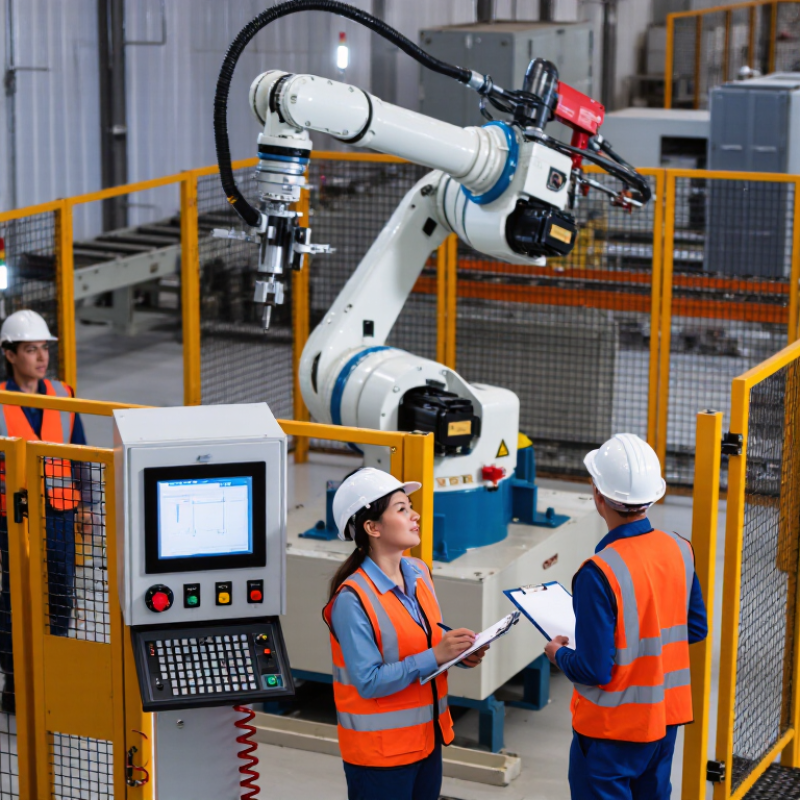
Assess each robot cell from floor level and operator eye height. Record pinch points, unexpected motion, sharp tooling, stored energy, and access during faults. Protective measures may include fixed guarding, interlocked gates, presence-sensing devices, safe speed limits, and clearly controlled energy isolation. Controls should reduce risk before relying on warnings or training. OSHA guidance also emphasizes that setup, maintenance, and programming require special attention because safeguards may be bypassed temporarily. Test every protective function under realistic conditions, including a failed sensor or opened gate.
Tips: Photograph each access point. Observe real work, not only normal production. Ask operators where shortcuts occur. Verify stopping time after tooling changes. Document who approved each safeguard and when it was tested. Keep records accessible near the cell. Reassess after software changes, new tooling, production increases, or near misses. In practice, teams often overestimate training and underestimate recovery tasks. That gap deserves review.
(Sources: ANSI/RIA R15.06; International Federation of Robotics, World Robotics 2024; OSHA, Robotics Safety.)
Implementing Installation, Operation, and Maintenance Procedures
How to Meet RIA Standards for Industrial Robots?
Implementing Installation, Operation, and Maintenance Procedures
Safe compliance begins before the robot arrives. Conduct a documented risk assessment for the cell, tooling, fixtures, and nearby traffic. Apply applicable ANSI/RIA R15.06 and ISO 10218 requirements during design and installation. Define safeguarded spaces, emergency stops, access points, and controlled restart procedures.
According to the International Federation of Robotics’ World Robotics 2024 report, 541,302 industrial robots were installed globally in 2023. More robots mean more workplaces requiring disciplined procedures.
Installation teams should verify anchoring, cable routing, guarding, safety-device response, and programmed speed limits. Record every test result. During operation, trained personnel should use approved modes, inspect the cell, and never bypass an interlock for convenience. Procedures must explain recovery after faults, including who may enter the safeguarded space and how energy is isolated. Maintenance records should include lubrication, wear checks, software changes, and replaced safety components.
The International Labour Organization emphasizes that effective occupational safety depends on prevention, worker training, and continual improvement.
Tips: Keep procedures beside the control station. Use photographs for inspection points. Test emergency stops at scheduled intervals. Review near misses, not only injuries. A checklist is useful, but it can become theater. Operators may sign it without seeing a loose connector or damaged guard. Supervisors should observe real work periodically and revise procedures after awkward tasks, unplanned stops, or layout changes. Train contractors separately when their access, tools, or responsibilities differ.
Verifying Compliance Through Testing, Training, and Documentation
How to Meet RIA Standards for Industrial Robots?
Meeting RIA standards requires more than installing guards around a robot cell.
Compliance should be proven through repeatable testing, qualified training, and controlled documentation. Begin with a documented risk assessment covering motion, pinch points, tooling, access, and unexpected restart conditions. Test emergency stops, enabling devices, interlocks, safeguarding distances, and restricted operating modes. Record each result, including the test date, equipment condition, and responsible technician.
Training must match real workplace tasks.
Operators should practice normal production, safe recovery, fault response, and shutdown procedures. Maintenance staff need deeper instruction on isolation, stored energy, inspection, and controlled manual movement. Keep attendance records and verify competence through practical demonstrations. A signed form alone is weak evidence. It may confirm presence, not understanding.
Tips:
Use photographs during validation. Label each safety device. Store revisions centrally. Review records after every modification.
Documentation should connect the entire safety process.
Include the risk assessment, electrical and pneumatic drawings, cell layout, safety circuit checks, training records, maintenance procedures, and corrective actions. During an audit, missing revision details can create uncertainty, even when the equipment operates safely.
A clean checklist can still hide a poorly tested assumption. Revisit it with operators and technicians. Their observations often reveal awkward access, confusing reset locations, or recovery steps that look safe only on paper. Use the current applicable RIA requirements and local regulations, then obtain review from competent safety professionals when uncertain.