Top 10 Types of Automated Material Handling Equipment
Modern warehouses are changing quickly, but automation is not a universal solution. The right equipment depends on product weight, travel distance, storage height, order volume, and available floor space. This guide introduces the top 10 types of automated material handling equipment used across warehouses, factories, and distribution centers. Each system solves a different movement or storage challenge.
Automated storage and retrieval systems can place pallets in tall racks with impressive accuracy. Conveyor systems move cartons between picking, packing, and shipping areas. Automated guided vehicles and autonomous mobile robots can transport loads across changing routes. Palletizers, depalletizers, sortation systems, robotic arms, vertical lifts, and shuttle systems provide other valuable capabilities. Small details matter. A barcode failure can interrupt an entire workflow. Poorly planned traffic lanes can create delays instead of removing them.
Reliable decisions require more than comparing equipment prices. Engineers should review safety controls, maintenance access, software compatibility, energy use, training needs, and future expansion. Site testing, supplier documentation, and performance data can reveal limitations that sales presentations may overlook. No system is perfect. A robot may reduce walking time but still require careful human supervision. That weakness deserves attention. By examining real operating conditions, this overview helps readers understand where automated material handling delivers practical value and where manual processes may remain more sensible.
Automated Material Handling Equipment: Purpose, Scope, and Main Categories
Top 10 Types of Automated Material Handling Equipment
Automated material handling equipment moves, stores, identifies, and presents goods with limited manual intervention. Its purpose is practical: reduce travel, protect workers, improve inventory accuracy, and maintain steady throughput. The scope reaches warehouses, factories, distribution centers, cold storage rooms, and fulfillment areas. It covers receiving, putaway, picking, packing, sorting, and shipping.
The main types include conveyors, automated storage and retrieval systems, automated guided vehicles, autonomous mobile robots, sorters, robotic picking arms, palletizers, depalletizers, vertical lift modules, and automated cranes. Each type solves a different movement problem. A conveyor can carry cartons between workstations. A sorter can divert packages into separate shipping lanes. A vertical lift module can use ceiling height when floor space is limited. Automated cranes suit dense pallet storage but require careful structural planning.
System choice depends on load size, speed, aisle width, software integration, and future growth. In a cold store, equipment needs suitable materials and reliable controls. In a busy packing area, small delays can create a visible backlog. Integration matters as much as hardware. Poor inventory data can make advanced equipment perform badly. No system is perfect. Sensors may need cleaning, grippers may miss irregular cartons, and staff still need practical training. A dependable design includes safe access, clear maintenance zones, tested emergency procedures, and measurable performance targets.ಿವು
Conveyor Systems: Belt, Roller, and Chain-Based Material Movement
Conveyor systems remain the practical core of automated material handling. Belt conveyors move cartons, bags, and irregular loads across long, continuous routes. Roller conveyors suit rigid boxes and pallet transfers, especially where accumulation is needed. Chain conveyors handle heavier loads, including pallets, bins, and metal containers, with strong traction and stable positioning.
The International Federation of Robotics reported 541,302 industrial robots were installed worldwide in 2023. That figure signals a wider shift toward connected material movement, but conveyors still determine flow quality. Sensors can detect gaps, jams, and load positions. Variable-speed drives can reduce energy use during quieter periods. Small design choices matter.
Belt systems need careful tracking and cleaning. Roller systems need accurate spacing and controlled back pressure. Chain systems require lubrication, guarding, and regular tension checks. The MHI 2024 Annual Industry Report identifies automation as a continuing investment priority across supply chains. Yet automation is not automatically efficient. I have seen poorly matched conveyors create bottlenecks beside fast robotic cells. Throughput estimates can also fail when package sizes change. A short pilot run, measured with real loads, often reveals more than a polished simulation.
Automated Storage Systems: AS/RS, Vertical Lifts, and Carousels
Automated storage systems are reshaping the top ten categories of material handling equipment. AS/RS units place pallets or cartons into dense rack locations, then retrieve them through software-controlled cranes or shuttles. Vertical lift modules move trays inside enclosed towers, reducing walking and using ceiling height. Horizontal and vertical carousels rotate inventory to an operator station, like a quiet revolving cabinet.
The 2024 MHI Annual Industry Report found that 43% of respondents already use robotics and automation. It also reported that 73% expect adoption within five years. These figures support investment, but they do not guarantee payback. In real facilities, SKU changes, damaged labels, and poor slotting can reduce performance. A system may achieve high storage density yet create slower replenishment. That trade-off deserves measurement.
Tips: Measure order lines per hour, retrieval accuracy, travel distance, and energy use before selecting equipment. Use AS/RS for stable, high-volume inventory. Consider vertical lifts where floor space is expensive. Carousels can suit small items with repetitive picking. Keep manual access points available. Failures happen. A practical pilot often reveals more than a polished simulation. Cite: MHI, 2024 Annual Industry Report.
| No. | Equipment Type | Primary Function | Typical Load or Unit | Typical Operating Range | Best-Fit Applications | Key Advantages | Important Considerations |
|---|---|---|---|---|---|---|---|
| 1 | Unit-Load AS/RS | Automatically stores and retrieves pallets or large standardized loads in high-bay racks. | Pallets, totes, or containers; commonly up to approximately 1,500 kg per load. | High-density storage; rack heights commonly range from about 10 to 40 m, depending on facility design. | Pallet warehouses, manufacturing plants, cold storage, and distribution centers. | High storage density, accurate inventory control, reduced forklift traffic, and improved operator safety. | Requires standardized loads, precise integration, significant capital investment, and suitable building height. |
| 2 | Mini-Load AS/RS | Automatically handles smaller containers, cartons, trays, or totes within compact storage aisles. | Totes, trays, cartons, and bins; commonly about 20–300 kg per load. | Medium- to high-density storage with multiple levels and automated aisle equipment. | Order fulfillment, spare parts, electronics, pharmaceuticals, and light manufacturing. | Fast access to many stock-keeping units, accurate put-away, and efficient use of vertical space. | Load dimensions and weight must be controlled; throughput depends on workstation and conveyor design. |
| 3 | Vertical Lift Module (VLM) | Stores trays in a vertically arranged tower and delivers the required tray to an operator-access opening. | Small parts, tools, cartons, and trays; often about 100–500 kg per tray. | Typical system heights range from approximately 2 to 15 m, subject to ceiling and load requirements. | MRO stores, tooling rooms, medical supplies, electronics, and compact warehouses. | Saves floor space, improves picking ergonomics, protects inventory, and supports controlled access. | Best suited to compatible tray sizes; very large or irregular items may require another system. |
| 4 | Horizontal Carousel | Rotates a series of carriers horizontally to bring stored items to a fixed picking station. | Bins, cartons, totes, and hanging garments; commonly tens to several hundred kilograms per carrier. | Low- to medium-height installations, frequently arranged in workstations or pods. | Piece picking, apparel, spare parts, order consolidation, and document or product storage. | Reduces walking, provides high pick accuracy, and can combine several units at one workstation. | Requires a suitable footprint and works best when item profiles and storage locations are relatively stable. |
| 5 | Vertical Carousel | Moves shelves, trays, or carriers vertically around a continuous loop to present inventory at an access point. | Small parts, tools, components, and cartons; load capacity varies by carrier and configuration. | Commonly about 2–10 m high, with multiple carriers arranged vertically. | Maintenance stores, manufacturing cells, tool rooms, and areas with limited floor space. | Uses vertical space efficiently, reduces operator travel, and can improve security and item visibility. | Carrier capacity, item dimensions, and access-window size limit the range of suitable products. |
| 6 | Shuttle-Based Storage System | Uses autonomous shuttles to store and retrieve totes, cartons, or pallets within rack channels. | Totes, cartons, trays, or pallets; capacity depends on the shuttle and rack configuration. | Dense multi-level storage with scalable numbers of shuttles and lifts. | E-commerce fulfillment, grocery distribution, buffering, and high-volume case handling. | Scalable throughput, good storage density, flexible lane management, and reduced fixed aisle equipment. | Needs reliable controls, battery or charging management, and careful coordination with lifts and conveyors. |
| 7 | Automated Guided Vehicle (AGV) | Transports materials along predefined routes using navigation, sensors, and onboard control systems. | Pallets, carts, racks, bins, and production materials; payloads range from light loads to several tonnes. | Often operates at approximately 0.8–2.0 m/s, depending on vehicle type and site safety conditions. | Factory logistics, pallet movement, line-side delivery, and warehouse-to-production transport. | Repeatable transport, reduced manual handling, and relatively predictable route planning. | May require route markers or mapped infrastructure; traffic, floor quality, and charging affect performance. |
| 8 | Autonomous Mobile Robot (AMR) | Moves goods or carts dynamically through a facility using onboard mapping, sensors, and traffic management. | Totes, carts, shelves, parcels, and work-in-process materials; payloads vary by platform. | Common travel speeds are approximately 1–2 m/s in indoor operations, subject to safety rules. | Goods-to-person picking, replenishment, kitting, sorting support, and flexible production logistics. | Flexible routing, easier layout changes, and reduced dependence on fixed conveyor paths. | Performance depends on floor conditions, pedestrian interaction, wireless coverage, and fleet orchestration. |
| 9 | Automated Conveyor System | Moves cases, cartons, totes, pallets, or parcels between receiving, storage, picking, packing, and shipping areas. | Cartons, totes, parcels, pallets, and trays; load limits depend on conveyor type. | Typical belt or roller conveyor speeds range from about 0.3–2.0 m/s. | Distribution centers, parcel handling, manufacturing, sortation, and packing operations. | Continuous flow, predictable routing, high repeatability, and easy connection between process areas. | Fixed layout, accumulation control, guarding, noise, maintenance access, and product compatibility must be considered. |
| 10 | Robotic Palletizing and Depalletizing System | Automatically builds pallet loads or removes cases from pallets according to programmed patterns. | Cases, cartons, bags, trays, and pallets; payload depends on robot and end-of-arm tooling. | Many systems handle approximately 10–30 cycles per minute, depending on load, pattern, and travel distance. | Food and beverage, consumer goods, warehousing, manufacturing, and distribution operations. | Consistent stacking, reduced repetitive lifting, programmable patterns, and improved workplace ergonomics. | Requires stable product presentation, suitable grippers, safety guarding, and accurate pallet or case positioning. |
Mobile Handling Equipment: AGVs and Autonomous Mobile Robots
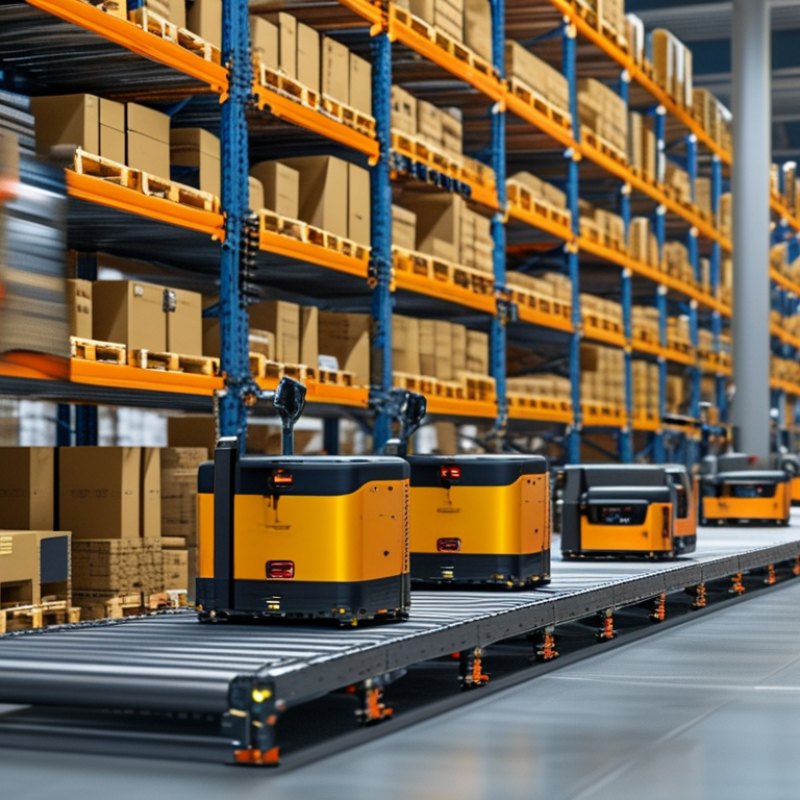
Automated guided vehicles, or AGVs, move pallets along mapped routes, magnetic paths, or floor markers. Autonomous mobile robots, or AMRs, use sensors and software to adjust routes around people and temporary obstacles. This difference matters in busy warehouses. An AGV may offer predictable pallet transport between fixed stations. An AMR can collect a tote from one aisle, pause at a crossing, and reroute when another vehicle blocks the path.
Industry data shows why mobile handling deserves attention. The 2024 MHI Annual Industry Report found that 43% of surveyed supply-chain organizations already used robotics and automation. The same report stated that 88% expected to increase automation investment over the following five years. The International Federation of Robotics reported 541,302 industrial robots installed worldwide in 2023, showing broader automation momentum. These figures do not guarantee a suitable mobile fleet. Site conditions decide more.
A practical assessment should measure travel distance, payload weight, charging time, aisle width, and order peaks. A fleet manager should also track idle minutes and failed missions. Small details matter. Dusty floors can reduce sensor confidence. Poorly marked pedestrian crossings create hesitation. A clean simulation can mislead. I would not choose AMRs simply because they appear more flexible. AGVs may perform better when routes rarely change and transfer points remain stable. AMRs become stronger when product locations shift frequently. Deployment teams should test both systems during real shifts, then revise layouts, traffic rules, and human training.
Robotic Handling Equipment: Palletizers, Depalletizers, and Sortation Robots
Robotic handling equipment brings controlled movement to fast warehouse operations. Palletizers stack cartons, bags, or cases into stable unit loads. Depalletizers reverse that process when production lines need individual items. Sortation robots then direct products toward specific lanes, orders, or workstations.
A palletizer usually builds each layer with calculated spacing and weight distribution. This matters when a forklift turns sharply or a pallet waits in storage. Depalletizers need accurate gripping, especially when cartons lean after transport. Vacuum tools may handle smooth boxes well, while mechanical clamps suit heavier or uneven packages. Small errors can create large delays.
Sortation robots use scanners, sensors, and routing software to identify each item. They can move parcels across a grid, conveyor interface, or temporary staging area. Operators should test barcode quality, package dimensions, and peak hourly volume before installation. Data reveals the truth.
Safety controls remain essential. Guarding, emergency stops, access sensors, and clear maintenance procedures reduce operational risk. A reliable system also records faults instead of hiding them. In practice, no layout is perfect. Product mixes change, packaging weakens, and traffic patterns surprise planners. I would leave space for manual recovery and future adjustments. Automation should support trained workers, not pretend every exception can be predicted. Regular inspections of grippers, belts, sensors, and pallet alignment help preserve accuracy over time.
Related Posts
-
How to Optimize AGV Automation for Efficient Supply Chain?
-
Enhancing Warehouse Efficiency: The Impact of AGV Systems on Operational Costs and Throughput
-
Top 10 AGV Vendors Revolutionizing Warehouse Automation and Logistics in 2023
-

10 Best AMR Robots Transforming Warehousing and Logistics in 2023
-
Top 10 Benefits of Material Handling Robots for Your Business Efficiency
-
Top Trends in Automated Guided Vehicle System Technology Unveiled?