
Top AMR Automation Companies for Global Buyers
Choosing among the top AMR automation companies is not simply a matter of comparing robot models. Global buyers need to assess how each supplier handles site mapping, fleet coordination, safety features, service coverage, and integration with existing systems. A robot that moves smoothly in a showroom may behave differently around crowded aisles, changing inventory, or uneven floors. Real conditions matter.
Melonee Wise, robotics engineer and former Fetch Robotics CEO, has emphasized a practical principle: mobile robots should support real workflows and the people doing the work. That perspective is useful when comparing vendors. Ask for evidence from deployments resembling your own operation, not just polished demonstrations. Small details count.
This guide introduces leading suppliers and the capabilities buyers should examine, from autonomous mobile robots and fleet software to implementation and ongoing support. It also considers differences in scale, regional presence, and application focus. No shortlist can fit every warehouse or factory. Published specifications may not reveal the full cost of integration, and vendor claims deserve careful verification. That is an imperfect part of the process. Still, clear requirements and direct questions can help buyers identify an AMR automation partner suited to their sites, teams, and growth plans.
Understanding Autonomous Mobile Robots and Their Role in Automation
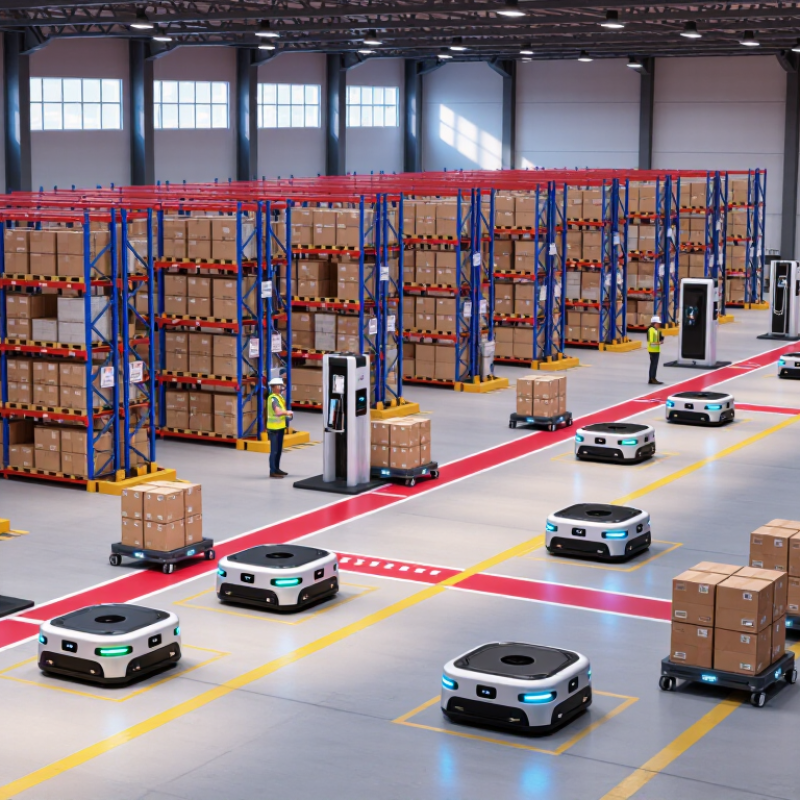
Autonomous mobile robots (AMRs) move materials through workplaces without fixed tracks. Onboard sensors help them detect obstacles and adjust routes as people, carts, and pallets shift around them. The International Federation of Robotics reported 86,000 mobile robots sold for transportation and logistics in 2022, then 113,000 in 2023, a 35% increase. These figures show growing adoption, not guaranteed savings at every site. Scale matters.
In a warehouse, an AMR might carry a tote from a picking aisle to a packing station, then receive its next task through fleet software. This can reduce repetitive walking and keep goods moving during busy shifts. Yet narrow aisles, uneven floors, and changing inventory can slow deployments. A route that works during a quiet test may fail when several workers and robots share the same space.
The IFR’s World Robotics reports track sales, but buyers also need site-level measures: completed trips, charging time, blocked routes, and human interventions. Not effortless. Teams should map workflows before choosing robot numbers or layouts. One useful review is to watch a full shift, not just a staged demonstration. Small delays add up. Teams may also need to rethink handoffs between robots, staff, and existing warehouse systems. That part is often underestimated.
Top AMR Automation Companies for Global Buyers - Understanding Autonomous Mobile Robots and Their Role in Automation
| AMR Solution Profile | Typical Material-Handling Task | Common Navigation Approach | Key Integration Requirements | Buyer Evaluation Points | Best-Fit Operating Environment |
|---|---|---|---|---|---|
| Cart or tugger AMR | Moves carts, racks, or trains of carts between production, storage, and dispatch areas. | Laser-based mapping and localization are common; some systems also use visual markers or other location references. | Cart coupling, traffic management, call buttons or workflow software, and links to production or warehouse systems. | Verify towing capacity, coupling method, route width, turning space, charging plan, and performance with the actual cart load. | Repetitive line-side replenishment and point-to-point transport on shared facility routes. |
| Unit-load or pallet AMR | Transports pallets or other unit loads between receiving, storage, production, and shipping areas. | Often uses onboard localization with mapped routes; sensors support obstacle detection and route adaptation. | Load-transfer stations, pallet presentation, warehouse management or execution systems, and fleet coordination. | Check load dimensions and weight, pickup and drop-off tolerances, floor condition, aisle clearance, and throughput at transfer points. | Facilities with repeatable pallet flows and defined handoff locations. |
| Autonomous forklift AMR | Lifts and transports pallets, including transfers to or from designated floor-level or rack interfaces. | Uses onboard sensors and localization to navigate; the required setup depends on the vehicle and facility layout. | Rack and pallet compatibility, safety controls, fleet software, and interfaces with warehouse or production systems. | Assess lift height, rated load at the required lift height, pallet condition, rack geometry, floor quality, and pedestrian interaction. | Warehouse and manufacturing operations where pallet handling can be standardized and access conditions are suitable. |
| Bin or tote-handling AMR | Delivers totes, bins, or shelves to picking, kitting, or replenishment workstations. | Typically navigates using mapped localization and onboard sensors; some workflows use fixed presentation points. | Storage layout, workstation design, order or inventory software, and synchronization with human work areas. | Compare bin and shelf dimensions, station ergonomics, picking workflow, software compatibility, and peak order demand. | E-commerce, parts distribution, and production kitting with frequent small-item movement. |
| Mobile manipulator | Combines a mobile platform with a robotic arm for tasks such as machine tending or handling items at multiple stations. | Combines mobile localization with arm positioning; task accuracy depends on the robot, end effector, and workcell design. | Robot-arm and tool integration, machine interfaces, safety assessment, and coordination between mobile and stationary equipment. | Validate reach, payload, cycle time, grasp reliability, station tolerances, and the complexity of the combined safety setup. | Structured workflows where mobile transport and a repeatable manipulation task are both required. |
| Fleet and traffic-management software | Coordinates missions, vehicle traffic, charging, task assignment, and status reporting across a mobile-robot fleet. | May manage vehicles using a shared map, traffic rules, mission queues, and defined interfaces. | Connection to warehouse, manufacturing, or enterprise systems; interoperability requirements should be agreed before deployment. | Confirm multi-vendor support where needed, interface responsibilities, cybersecurity provisions, reporting, and recovery procedures. | Operations with multiple vehicles, changing mission priorities, or a requirement to coordinate different automation systems. |
Selection note: AMR specifications and performance vary by system and site. Validate payload, speed, charging, localization, and throughput against the intended operating conditions. ISO 3691-4 addresses safety requirements for driverless industrial trucks and their systems; confirm applicable standards and regulatory requirements for each deployment.
Related Posts
-
What Is the Best AMR Automated Mobile Robot in 2026?
-

How to Choose the Right AMR Robot for Your Business Needs
-

2026 How to Integrate AI Robots into Everyday Life?
-

2026 Top Trends in Robotics Artificial Intelligence Innovations?
-
How to Ensure Robot Safety Standards are Met in 2025
-
How to Optimize AGV Automation for Efficient Supply Chain?