How to Choose the Best Automated Mobile Robots for Your Business?
In recent years, automated mobile robots (AMRs) have transformed various industries. Companies are increasingly relying on these innovative machines to enhance productivity and efficiency. Choosing the right AMR for your business can be challenging. With numerous options available, it’s crucial to assess your specific needs.
Understand your operational requirements. Consider factors like warehouse size, layout, and the type of goods handled. A robot that excels in one environment may not perform well in another. You should also evaluate the AMR's ability to integrate with existing systems. Compatibility issues can lead to costly delays and inefficiencies.
Don’t overlook the importance of support and maintenance. A reliable service provider can help you resolve technical issues quickly. Investing in training for your staff is also essential. This can maximize the benefits of automated mobile robots. Reflecting on these elements can lead to better decision-making for your business.

Understanding the Different Types of Automated Mobile Robots Available
When selecting automated mobile robots (AMRs) for your business, it's crucial to understand the types available. There are several AMR categories designed for different applications. For instance, some robots focus on material handling in warehouses. These robots can move goods efficiently and reduce labor costs. However, their navigation systems may struggle in complex environments.
Another type of AMR is known for its delivery capabilities. These robots are popular in hospitals and retail spaces. They transport items directly to users, improving service speed. But, they might encounter obstacles or require manual intervention, which can slow down the process.
Lastly, inspection robots play a vital role in quality control. They monitor production lines, helping in identifying defects. Yet, their reliance on sensors means they can miss certain issues. Proper assessment of your specific needs ensures that the chosen AMR can enhance your operations effectively. Choosing the right type is not always straightforward and may require trial and adjustment.
Assessing Your Business Needs and Specific Applications for Robots
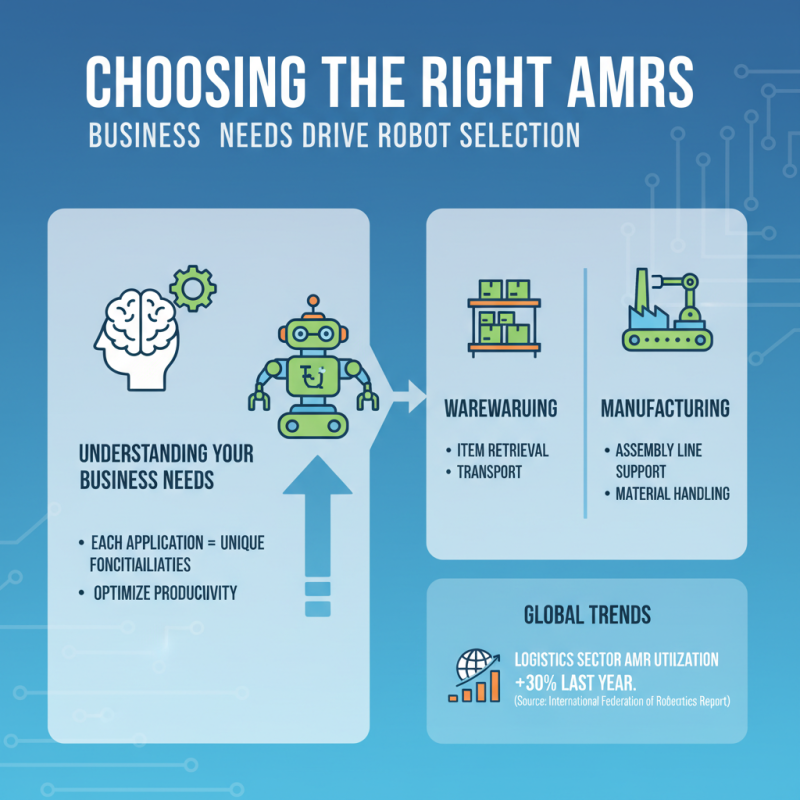
Choosing the right automated mobile robots (AMRs) begins with understanding your business needs. Each application requires unique functionalities. For instance, warehousing often demands efficient item retrieval and transport, while manufacturing focuses on assembly line support. According to a recent report by the International Federation of Robotics, the logistics sector saw a rise in AMR utilization by 30% in the last year. This trend highlights the importance of assessing specific requirements to optimize productivity.
Consider your operational challenges. Are you facing labor shortages or increasing demand? Enhanced efficiency is possible, but without clear objectives, investments can falter. Research shows that poorly implemented robotic systems can lead to a 15% drop in performance. The type of tasks your robots will handle directly influences your choice. An AMR suited for one industry might not fit another.
Testing and feedback cycles are vital. Real-world trials reveal imperfections in robotic systems. Many businesses find that initial expectations do not align with actual performance. Continuous evaluation helps refine processes and improve outcomes. Understanding your environment, tasks, and limitations is essential for maximizing AMR potential.
Evaluating Key Features and Technologies in Mobile Robot Options
When choosing automated mobile robots for your business, focus on key features and technologies that meet your specific needs. Start by evaluating navigation systems. Robots that use LIDAR or computer vision can adapt to dynamic environments. They offer precise mapping capabilities, enabling efficient pathfinding. However, consider the limitations of these technologies, as they may struggle in extreme lighting conditions.
Another critical feature to assess is payload capacity. Ensure the robots can handle your operational demands and transport necessary goods. Weight limitations can hinder efficiency. Examine battery life too. A robot that needs frequent charging can disrupt workflow, even if it has advanced capabilities. Slow or limited battery performance can lead to dissatisfaction over time.
Communication protocols are equally important. A mobile robot should easily integrate with your existing systems. Poor compatibility can lead to data silos and operational disarray. Take time to reflect on these aspects and weigh the pros and cons. Ultimately, the right decision requires careful consideration of your unique business landscape.
Key Features of Automated Mobile Robots for Business
Comparing Costs and Return on Investment for Automated Robots
When considering automated mobile robots for your business, costs play a vital role. An initial investment in technology can be daunting. However, examining long-term benefits is crucial. The total cost of ownership includes maintenance, training, and potential upgrades. Some robots require significant programming, which can escalate expenses.
Return on investment (ROI) takes time to manifest. Many businesses witness improvements in efficiency, yet the timeframe varies. An effective robot can reduce labor costs and minimize errors. Over time, labor savings can offset the initial outlay. Nonetheless, businesses should track performance metrics continually. Are you achieving the anticipated efficiency gains?
Comparing various options is essential. Some may offer lower purchase prices but have higher operational costs. Others might excel in reliability but become costly due to spare parts. Calculate the expected lifespan of the robot. Short-lived robots may lead to frequent replacements, negating savings. Careful analysis of costs and ROI ultimately guides informed decisions.
Finding Reliable Vendors and Support Services for Mobile Robotics
When considering automated mobile robots for your business, vendor reliability is key. Many newcomers overlook this aspect. Look for vendors with a solid track record. They should have experience in your industry. Research customer reviews and case studies. This can reveal their strengths and weaknesses. Sometimes, finding the right match requires patience.
Support services are just as important as the robots themselves. Quality support can make or break your experience. Check if the vendor offers training and maintenance. A good warranty is vital as well. Be wary of vendors who promise everything but deliver inconsistently. Initial impressions may be misleading. Trust your instincts and ask tough questions.
Building a relationship with the vendor can take time. Regular communication helps address issues before they escalate. Don’t shy away from expressing your concerns. Transparency is crucial in any partnership. Some vendors may not be fully honest about their capabilities. Verify their claims through independent sources. Always prioritize a partner who values your needs and growth.